
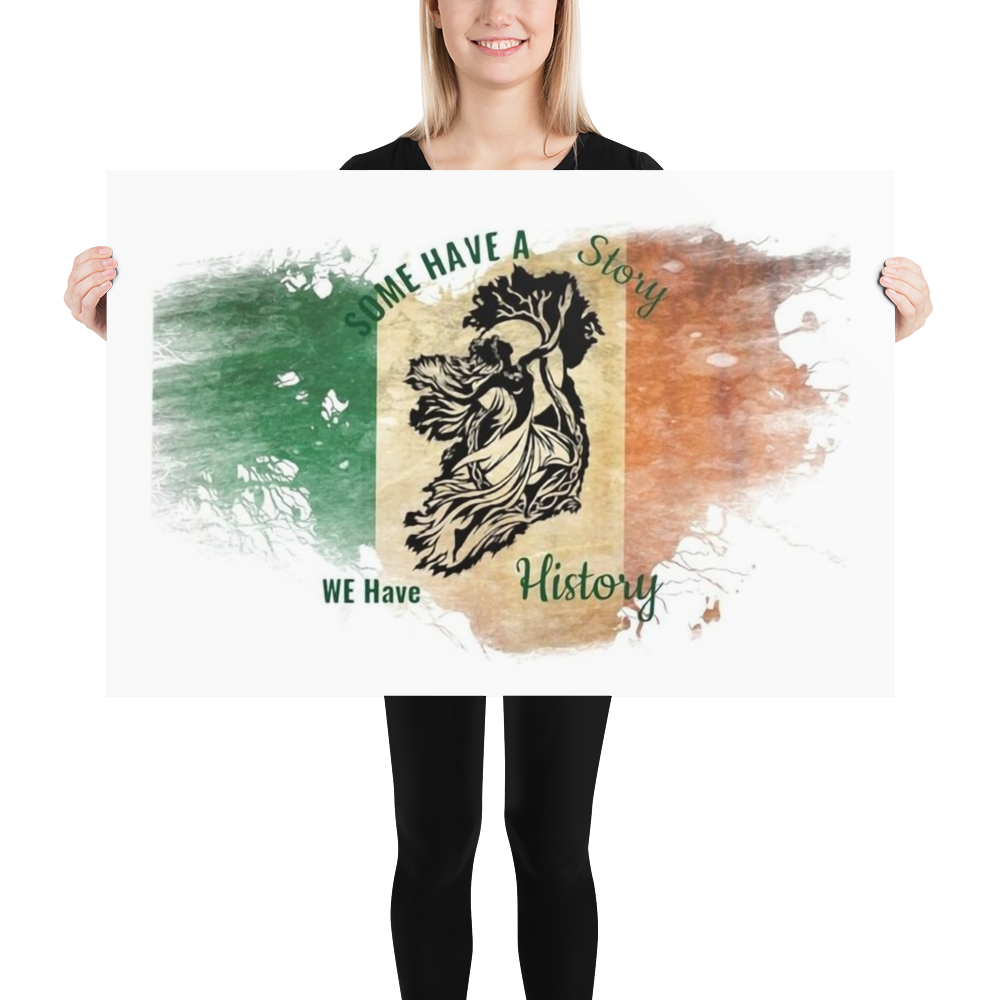
Ireland: Some Have a Story, We Have History


Ireland: Some Have a Story, We Have History

Ireland is a land rich in history, culture, and breathtaking landscapes. From its ancient Celtic roots to its vibrant modern identity, the Emerald Isle offers a tapestry of stories, legends, and historical events that have shaped not only the nation itself but also influenced the wider world.

Ancient Roots and Celtic Heritage

The history of Ireland stretches back thousands of years, with evidence of human activity dating to around 10,000 BC. The Celtic influence began around 500 BC, and it profoundly shaped the culture and traditions that are still celebrated today. The Celts left behind a legacy of art, language, and mythology, including:

  • Celtic Art: Intricate designs found in ancient manuscripts and stone carvings.

  • Gaelic Language: The native language of Ireland, still spoken in some regions.

  • Mythology: Rich tales of gods, warriors, and heroes like Cú Chulainn and Fionn mac Cumhaill.

The Arrival of Christianity

The arrival of Christianity in the 5th century, largely through the efforts of St. Patrick, marked a significant turning point in Irish history. This era saw the establishment of monasteries that became centers of learning and culture. The monks preserved ancient texts and produced stunning illuminated manuscripts, such as the famous Book of Kells.


Shop

Struggles for Independence

The struggle for Irish independence is a significant chapter in the nation's history. For centuries, Ireland was under English and later British control, leading to numerous uprisings and movements for autonomy. Key events include:

  • The 1798 Rebellion: An uprising against British rule inspired by the American and French Revolutions.

  • The Great Famine - An Gorta Mór (1845-1852): A devastating period that led to massive emigration and loss of life. a "blight of unusual character" devastated Ireland's potato crop, the basic staple in the Irish diet.

  • The Irish potato famine was not simply a natural disaster. It was a product of social causes. Under British rule, Irish Catholics were prohibited from entering the professions or even purchasing land. Instead, many rented small plots of land from absentee British Protestant landlords.

  • The Easter Rising (1916): A pivotal moment that eventually led to the establishment of the Irish Free State in 1922.


Shop

Conclusion

Ireland's history is a complex and fascinating narrative that intertwines with myth and legend. From its ancient Celtic origins to its modern-day achievements, Ireland's past is not just a story—it is a rich tapestry of events and influences that continue to shape its identity. The phrase "some have a story, we have history" encapsulates the depth and diversity of Ireland's journey through time.


Comments

Popular posts from this blog

Butterflies: Messengers of Irish Folklore

According to Irish folklore, butterflies are said to move between worlds and bring messages and warnings. They are said to be souls, waiting to be reborn on earth. This is perhaps why butterflies still play such a prominent role in material culture today, with a wide range of clothes, stationary, and other good coming decorated with butterflies. Butterflies with dark wings were said to warn of bad news such as an attack or failed crop, while white and yellow butterflies were told to bring good news such as a birth or success. In Irish mythology and folklore, butterflies have a special significance. According to Irish tradition, butterflies are believed to move between worlds and bring messages and warnings. They are considered to be souls waiting to be reborn on earth. This belief has contributed to the continued popularity of butterflies in modern-day material culture. Butterflies can be seen on a wide range of clothes, stationery, and other goods. Interestingly, the colour of the but...

Discovering Anamchara The Celtic Soul mate

  Anamchara Soul mate In the Celtic tradition, there is a beautiful understanding of love and friendship. One of the fascinating ideas here is the idea of soul-love; the old Gaelic term for this is anamchara. Anam is the Gaelic word for soul and chara is the word for friend.So anamchara in the Celtic world was the “soul friend.”With the anamchara you could share your inner-most self, your mind and your heart. This friendship was an act of recognition and belonging. When you had an anamchara, your friendship cut across all convention, morality, and category. You were joined in an ancient and eternal way with the “friend of your soul.”The Celtic understanding did not set limitations of space or time on the soul. There is no cage for the soul. The soul is a divine light that flows into you and into your Other. Learn More

The Burning Of Cork

The burning of Cork by British forces, took place during the Irish War of Independence on the night of 11th and 12th of December 1920.  The black and tans and british soldiers burned homes in the city, before looting and burning numerous buildings in the centre of Cork, Ireland's third-biggest city...  Many Irish civilians reported being beaten, shot at, and robbed by British forces.  Firefighters testified that British forces hindered their attempts to tackle the blazes by intimidation, cutting their hoses and shooting at them.  Two unarmed Irish men were also shot dead at their home in the north of the city. More than 40 business premises, 300 residential properties, the City Hall and Carnegie Library were destroyed by fires, many of which were started by British forces using incendiary bombs.  The economic damage was estimated at over £3 million (equivalent to approximately 150 million in 2022), while 2,000 were left jobless and many more became homeless... B...